CDM Principal Designer and Advisory Services
We provide expert support in fulfilling duties under the Construction (Design and Management) Regulations 2015, including design risk management, coordination, and project compliance advice.
What are the Construction (Design and Management) Regulations 2015 (CDM 2015)?
- CDM regulations are UK laws that set health, safety, and welfare standards for all construction projects from start to finish.
- The CDM Regulations 2015 are enforced by the Health and Safety Executive (HSE).
When do the CDM 2015 Regulations Apply?
CDM 2015 apply to all construction work in Great Britain, regardless of the size, cost, number of contractors or duration of the project.
- All Projects: They apply from the very start — during initial planning and design — through to the final build, maintenance, and eventual demolition.
- Scope of Work: They cover new builds, extensions,
conversions, renovations, repairs, maintenance, and fitting-out. Even
smaller jobs like domestic refurbishments fall under CDM rules.
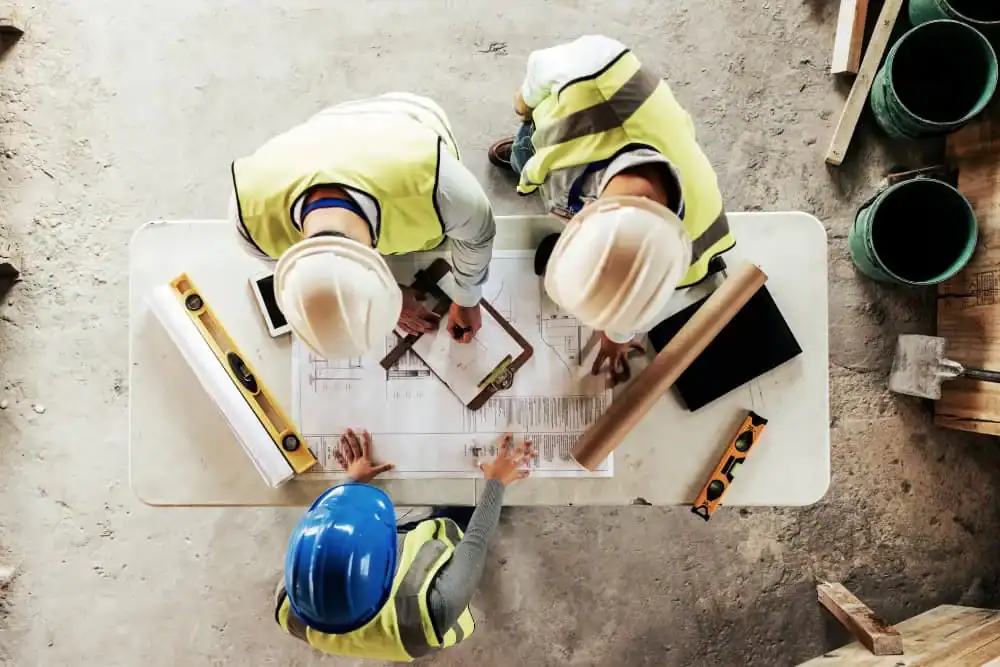
- Multiple Contractors: If a project involves more than one contractor working at any point, the client must formally appoint a Principal Designer and a Principal Contractor to coordinate safety.
What is Construction Work?
Under the CDM 2015, Construction is the following:
"construction work" means the carrying out of any building, civil engineering or engineering construction work and includes—
(a) the construction, alteration, conversion, fitting out, commissioning, renovation, repair, upkeep, redecoration or other maintenance (including cleaning which involves the use of water or an abrasive at high pressure, or the use of corrosive or toxic substances), de-commissioning, demolition or dismantling of a structure;
(b) the preparation for an intended structure, including site clearance, exploration, investigation (but not site survey) and excavation (but not pre-construction archaeological investigations), and the clearance or preparation of the site or structure for use or occupation at its conclusion;
(c) the assembly on site of prefabricated elements to form a structure or the disassembly on site of the prefabricated elements which, immediately before such disassembly, formed a structure;
(d) the removal of a structure, or of any product or waste resulting from demolition or dismantling of a structure, or from disassembly of prefabricated elements which immediately before such disassembly formed such a structure;
(e) the installation, commissioning, maintenance, repair or removal of mechanical, electrical, gas, compressed air, hydraulic, telecommunications, computer or similar services which are normally fixed within or to a structure.
What is the Principal Designer?
A principal designer is an individual or organization appointed by a client to plan, manage, and coordinate health, safety, and regulatory compliance during the pre-construction phase of a building project.
This role was covered by the CDM Coordinator under previous CDM 2007 Regulations, now the Principal Designer.
Is a Principal Designer (PD) required?
The simple answer is if you are carrying out any construction work.
Under CDM 2015, a PD must be appointed in writing by the client on any project where it is foreseeable that more than one contractor will be working on the project at any time. This legal requirement applies regardless of the size or duration of the project. If a client fails to make this appointment, the client becomes legally liable for fulfilling the PD duties themselves.
Furthermore, if a project is expected to last longer than 30 working days and have more than 20 workers on site at any point, or exceed 500 person-days of construction work, it is classed as a notifiable project. These projects must be formally reported to the Health and Safety Executive (HSE) using an F10 notification form.
Important note: Even on smaller, non-notifiable projects, Client and Principal Designer duties under CDM 2015 still apply as long as there is more than one contractor. Domestic clients are also covered; the duty typically transfers to the contractor or principal contractor by default, but the underlying legal requirement does not disappear.
A Principal Designer must have the knowledge, skills, training, and experience to plan, manage, monitor, and coordinate health and safety during the pre-construction phase, rather than just ticking a compliance box.
What a Principal Designer from AM Safety Specialists Ltd Actually Does
Our Principal Designers manage the pre-construction phase end-to-end. This includes assessing and advising on the competence of designers and duty holders, and coordinating health and safety input across designers, contractors, and the client team. We help to identify, eliminate, or control foreseeable risks at the design stage before they become site hazards.
Additionally, we handle the preparation and issuing of Pre-Construction Information (PCI) to all relevant parties and compile the Health and Safety File, which is handed to the client for future maintenance, refurbishment, and demolition works. Where required, we submit the F10 notification to the HSE and continually review design changes throughout the construction phase to ensure ongoing compliance.
Early appointment matters. A Principal Designer brought in after key design decisions are made can only manage risk retrospectively. Appointing a Principal Designer at the concept stage allows us to influence the design out of the hazard entirely.
Why Appoint AM Safety Specialists Ltd as the Principal Designer?
- Sector experience at scale: Our Principal Designers have delivered CDM Principal Designer duties on projects for organisations both large blue chip and small domestic projects, including the BBC, Eurostar, Thomson, and the Co-operative Group.
- Qualified and competent personnel: We supply professionals who meet the CDM 2015 definition of a competent Principal Designer, not just a generalist consultant.
- UK-wide coverage: We support both notifiable and non-notifiable projects across all sectors throughout the United Kingdom.
- Full documentation handled: We manage the F10 notification, Pre-Construction Information, and Health and Safety File production entirely on the client's behalf.
- Ongoing design-stage review: We do not disappear after appointment; we actively monitor design changes through to project completion.
Frequently Asked Questions
- Does a client need a Principal Designer on a small project? Yes, if the project involves more than one contractor. CDM 2015 duties apply to construction projects of all sizes. Formal notification (F10) is only required once a project meets the specific time and worker thresholds, but Client and design-team duties exist regardless of whether the project is notifiable to the HSE.
- What happens if a client does not appoint a Principal Designer when required? Failure to comply with CDM 2015 can result in HSE enforcement notices, project stop-work orders, unlimited fines, and personal liability for directors in serious cases. Additionally, if the client fails to appoint a Principal Designer, the client legally assumes all the duties of the Principal Designer.
- When should a Principal Designer be appointed? As early as practicable, ideally at the concept or feasibility stage, before key design decisions are locked in.
- Can the same person be both Principal Designer and Principal Contractor? In some cases, yes, provided they meet the competence requirements for both roles, though this is assessed project by project.